
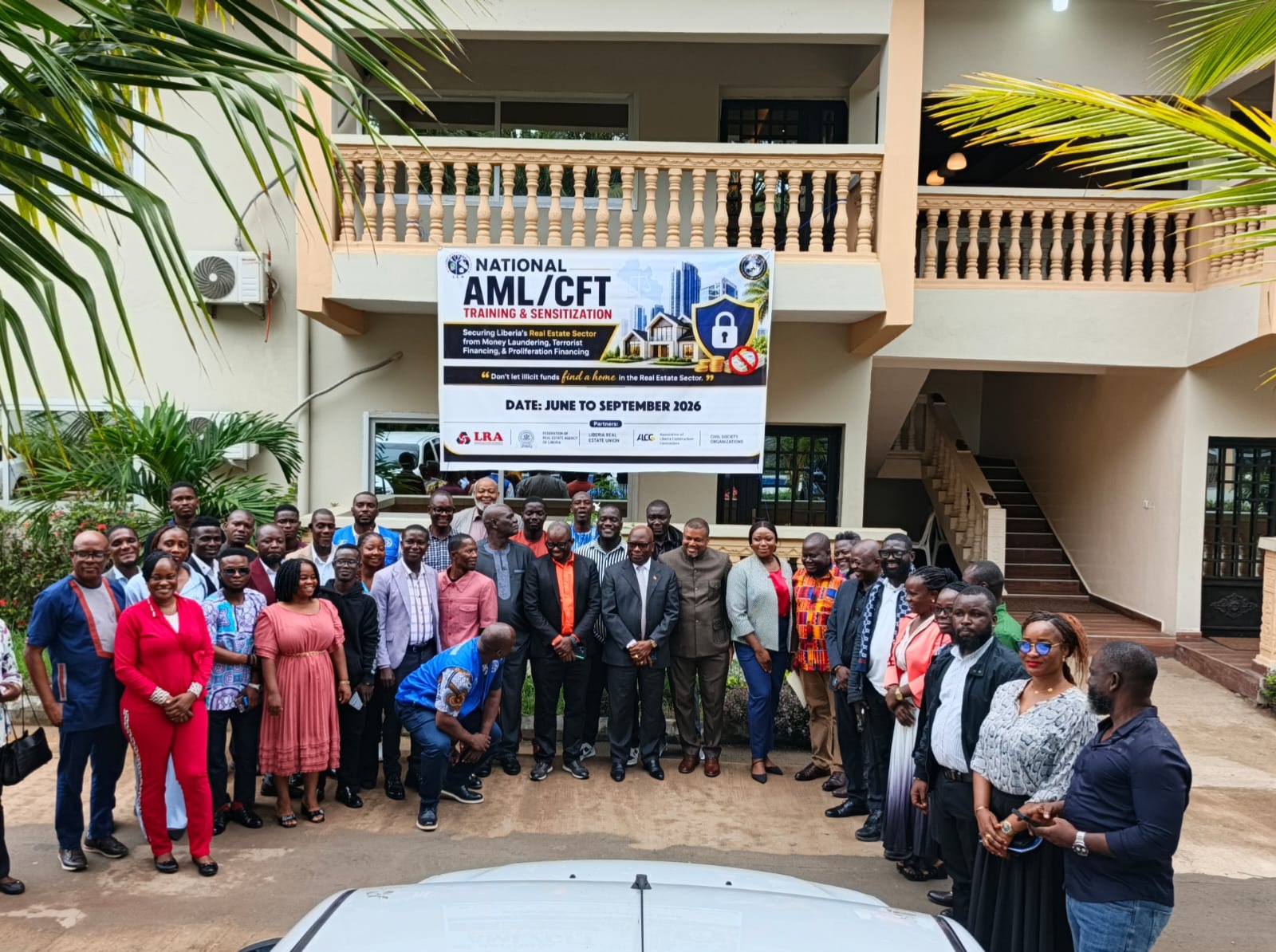
Two Regulatory Institutions, the Financial Intelligence Agency of Liberia (FIA) and the Liberia Land Authority (LLA), have officially launched the National AML/CFT awareness initiative that is aimed at helping to strengthen regulations and compliant in Liberia’s “profitable” real estate sector.
This nationwide exercise follows the completion of a sectorial risk assessment which was conducted in the real estate sector in 2024 to address deficiencies identified by Liberia in her National Risk Assessment (NRA) of 2019 and confirmed by the Inter-Governmental Action Group Against Money Laundering in West Africa (GIABA) in Liberia’s second-round mutual evaluation report concerning the country’s real estate sector.
The FATF “classifies real estate agents” as Designated Non-Financial Businesses and Professions (DNFBPs) under Recommendations 22 and 23, requiring them to apply Customer Due Diligence (Rec. 10) and a risk-based approach (Rec. 1) to all property transactions. Key obligations include identifying the beneficial owner and source of funds for both buyer and seller, reporting suspicious transactions to the Financial Intelligence Unit, and keeping records for at least five years.
In response, a sectoral risk assessment was conducted, and a dedicated AML/CFT regulation for the real estate sector was developed and validated by the Financial Intelligence Agency (FIA) in collaboration with the Liberia Land Authority (LLA) and other stakeholders in recognizing LLA as the sector’s prudential regulator. This initiative forms part of Liberia’s broader commitment to implementing the National AML/CFT Action Plan and adhering to Financial Action Task Force (FATF) recommendations.
The Real Estate Sector nationwide awareness campaign commenced from June to September of 2026 and involves key stakeholders from public and private institutions in Montserrado County and other parts of Liberia.
The stakeholder institutions include the Liberia Revenue Authority (LRA), Federation of Real Estate Agency of Liberia, Liberia Real Estate Union, Association of Liberia Construction Contractors, amongst others.
Presentations made highlighted trends and methods about Liberia’s real estate sector, red flags and case studies in the sector, a regulatory roadmap, an overview of the FIA, and the role of the Liberia Land Authority.
Speaking during the official launching ceremony, OIC Mohammed A. Nasser elaborated that the National AML/CFT Training, Sensitization, and Awareness for Liberia’s Real Estate Sector is being officially launched to help protect and properly regulate that critical sector.
According to the FIA OIC, the real estate sector in Liberia has been identified as highly vulnerable to Money Laundering (ML) and Terrorist Financing (TF) risks. He stated that both the National Risk Assessment and Liberia’s second round of Mutual Evaluation Report highlighted these vulnerabilities.
He mentioned that the objective of this national exercise is to conduct a nationwide awareness and sensitization for all stakeholders and other concerned actors in the real estate sector. This cannot be overemphasized as it will greatly help to achieve the following objectives: strengthening compliance with AML/CFT regulations; enhancing understanding of ML/TF risks specific to real estate; and improve collaboration between regulators, real estate actors, and community stakeholders.
Hon. Nasser noted that this initiative is aimed at: building technical capacity of sector stakeholders to identify, prevent, and report ML/TF suspicious activities; create awareness to the public on ML/TF red-flags and vulnerabilities in the sector.
The FIA OIC highlighted the risks of using proceeds of corruption and illicit funds to acquire real properties and the consequence thereof.
Also speaking during the official launch of the national AML/CFT sensitization program about the real estate sector, Hon. Samuel F. Kpakio, Chairman of the Liberia Land Authority, asserted that the Real Estate Sector Regulatory Framework and Anti-Money Laundering/Countering the Financing of Terrorism (AML/CFT) Compliance Initiative marks a significant step toward strengthening transparency, accountability, and oversight in Liberia’s real estate sector.
Chairman Kpakio termed the national AML/CFT sensitization exercise a historic milestone under the administration of President Joseph Nyumah Boakai Sr., aimed at rebranding Liberia’s Real Estate Sector to help enhance regulation and governance.
According to the LLA Chairman, the real estate sector sensitization initiative is aimed at addressing longstanding challenges confronting one of the country’s most strategic sectors, including weak oversight, informal transactions, land disputes, fraud, revenue leakages, and exposure to illicit financial activities.
He explained that enhancing regulation in the real estate sector is not only about introducing regulations, adding that it concerns establishing a new national framework that is built on transparency, accountability, professionalism, compliance, and sustainable economic governance.
The LLA Chairman said the Authority derives its mandate from the Liberia Land Authority Act of 2016, particularly Section 8, which empowers the LLA to regulate and administer land governance systems, land valuation functions, and related regulatory responsibilities nationwide.
He intoned that the Land Rights Act of 2018 further strengthens the national framework for land governance, tenure security, registration, and responsible land management.
Hon. Kpakio expressed appreciation for the partnership between the LLA and FIA, which represents the convergence of land governance and financial integrity, intended to protect investments and improve public confidence in property transactions.
The newly launched AML/CFT regulations for the real estate sector introduce several compliance requirements, including Know Your Customer (KYC) procedures, Customer Due Diligence (CDD), suspicious transaction reporting, risk classification measures, recordkeeping obligations, and enhanced due diligence for high-risk transactions.
Chairman Kpakio stressed that the measures are aimed at safeguarding business activities and positioning Liberia as a credible country for both domestic and foreign investments.
Meanwhile, as part of the implementation exercise, the LLA and the FIA are anticipated to conduct awareness and stakeholder engagement activities across several counties to ensure that practitioners and communities understand the new regulatory requirements.
He urged real estate agents, brokers, developers, surveyors, appraisers, financial institutions, legal practitioners, construction companies, and other stakeholders to cooperate fully with the ongoing reform drive.