
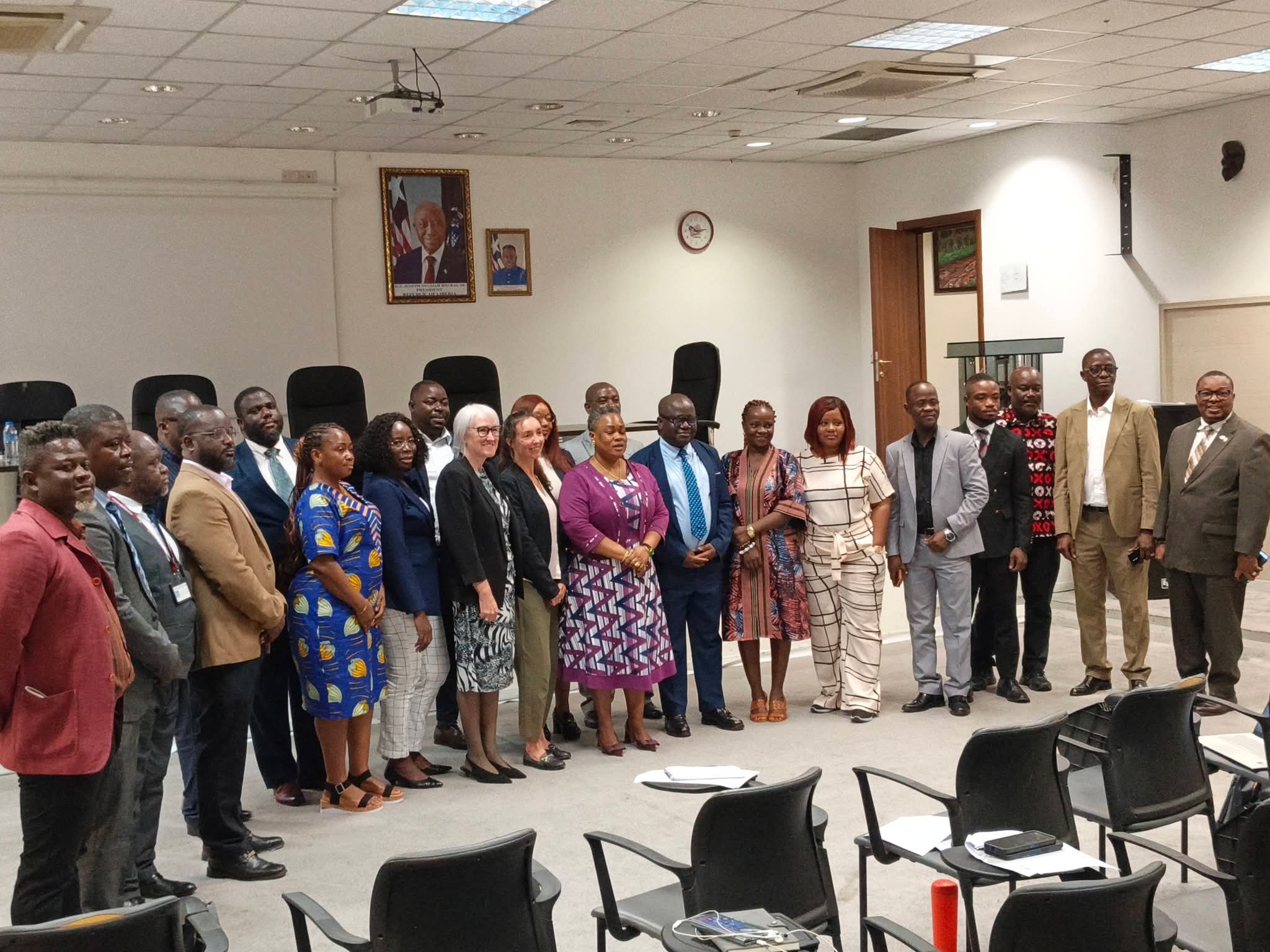
Representatives of the United Kingdom’s His Majesty Treasury Technical Assistance Unit on Tuesday, July 28, 2026, commenced a four-day technical assistance training workshop in Monrovia. The training geared towards strengthening Liberia’s Anti-Money Laundering, Countering the Financing of Terrorism, and Countering Proliferation Financing (AML/CFT/CPF) framework.
Held at the headquarters of the Central Bank of Liberia (CBL), the training is being attended by participants from key competent authorities and aims to address identified gaps through practical discussions and sharing of international best practices.
According to organizers from the FIA and CBL, the training is designed to improve supervisory effectiveness, preventive measures, inter-agency coordination, and the implementation of a risk-based approach – consistent with FATF Immediate Outcomes Three and Four (IO3 & 4) – which emphasize supervision and preventive measures, respectively.
The training modules cover topics such as national and sectorial risk assessment, supervisory strategies, beneficial ownership, targeted financial sanctions, proliferation financing, compliance, remediation, and enforcement. These areas are critical to enhancing Liberia’s compliance with the Financial Action Taskforce (FATF) standards, authorities said.
Participating institutions include the Financial Intelligence Agency of Liberia (FIA), Central Bank of Liberia (CBL), Liberia Business Registry, UK Embassy near Monrovia, Ministry of Mines and Energy, Liberia Institute of Certified Public Accountants, Ministry of Finance and Development Planning, and the Ministry of Justice, among others.
Speaking at the opening ceremony, FIA Deputy Director General (DDG), Hon. Amos Y. Boakai, described the workshop as timely, noting that expectations from FATF, GIABA, international partners, and national commitments are increasing.
DDG Boakai said Liberia was in the process of finalizing its revised National Risk and multiple sectoral risk assessments, which he described as “essential” to building a credible risk-based supervisory system.
He, however, flagged several challenges: nascent supervision of Designated Non-Financial Businesses and Professions (DNFBPs), weak beneficial ownership verification frameworks, inadequate preparedness on proliferation financing, and inconsistent enforcement of DNFBPs.
“These concerns are substantive and directly impact Liberia’s capacity to preserve financial integrity, attract investments, and sustain international confidence,” Amos Y. Boakai lamented.
He disclosed that while steps are being taken on administrative sanctions, “a herculean task” remains on compliance with FATF Recommendation 7 (Targeted Financial Sanctions), as Liberia currently has no legislation or procedures to implement TFS in line with UNSC Resolutions on proliferation financing.
Hon. Boakai further urged supervisors to take ownership of the reformed roadmap developed alongside HM Treasury and to implement it “with urgency and discipline.” He thanked the CBL for hosting and the UK for its ongoing technical support.
DDG Boakai concluded that “delays or disjointed responses are not an option,” stressing that the future of Liberia’s AML/CFT/CPF system depends on decisive action in the coming months.
Also speaking, CBL Director for Regulation and Supervision J. Gblehbo Brown urged participants to make maximal use of the training to strengthen supervision and collaboration ahead of Liberia’s Third Round Mutual Evaluation.
He said the CBL is working with the FIA and other authorities to align frameworks with FATF and Basel standards, adding that adherence to AML/CFT is a “global obligation” needed to restore investors’ confidence.
For her part, UK Technical Assistance Advisor on Illicit Finance, Claire Wilson, commended the long-standing partnership between Liberia and the UK. She said the workshop will also address FATF’s changes in methodology ahead of Liberia’s Mutual Evaluation.
Wilson outlined key areas requiring attention – including: the lack of a legal framework for Terrorist Financing and Proliferation Financing (TF/ PF); full implementation of risk-based supervision; active unlicensed markets; and resource gaps. She also called for urgent transition from manual to digital systems; increased budget for AML; and stronger customer due diligence and beneficial ownership regimes.
Claire Wilson then pledged the UK Embassy’s continued collaboration with Liberian authorities ahead of GIABA’s next round of mutual evaluation.
Meanwhile, the ongoing face-to-face training follows earlier online sessions by the HM Treasury Technical Assistance Unit (TAU) and is intended to move Liberia “from discussion to implementation.”