
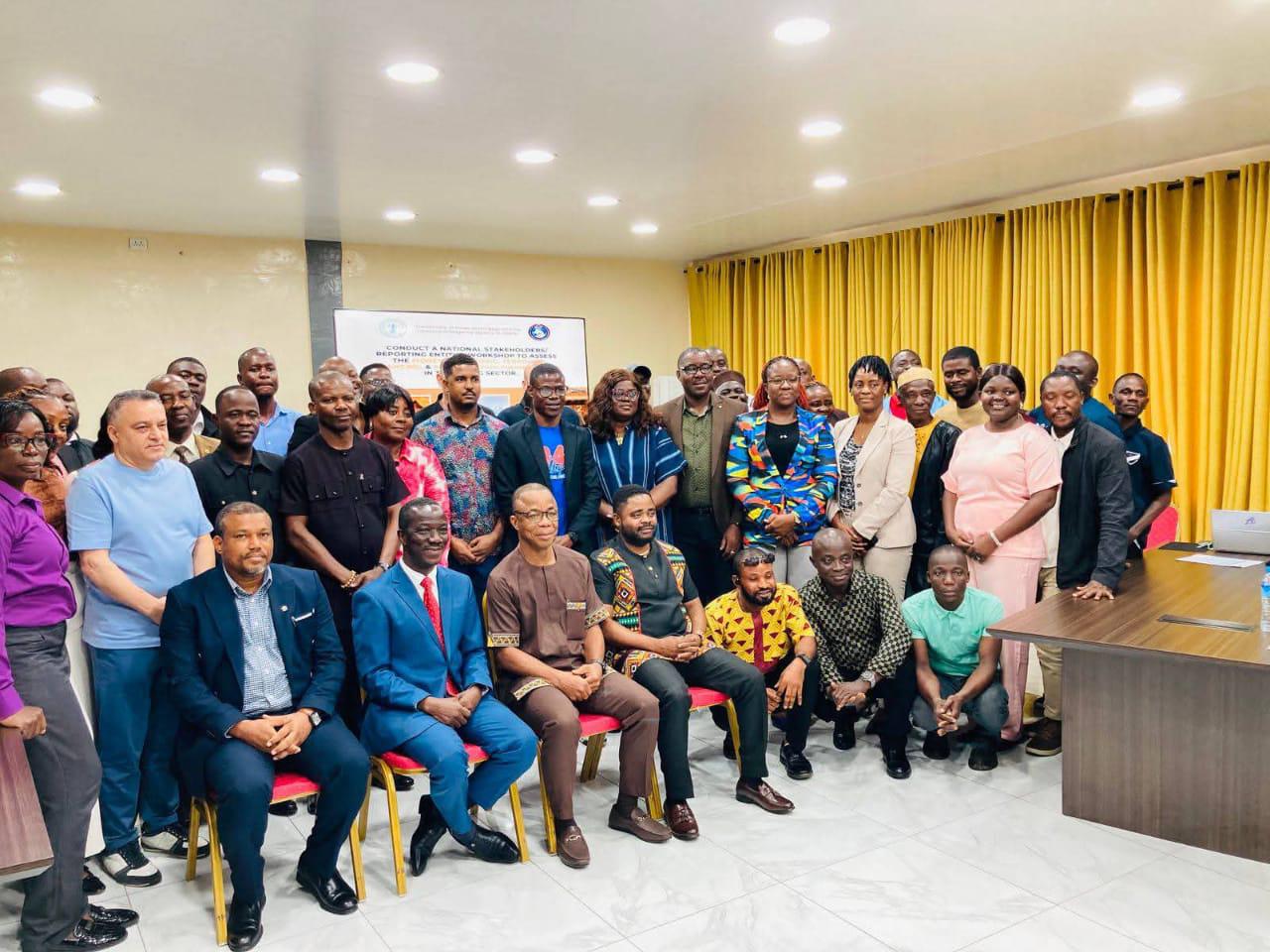
In addressing critical gaps identified in Liberia’s Second Round Mutual Evaluation Report (MER2), the Ministry of Mines and Energy and the Financial Intelligence Agency of Liberia (FIA), have joined forces to sensitize, raise-awareness, and collect data from key stakeholders on the vulnerabilities affecting Dealers in Precious Minerals and Stones (DPMS) or Heavy Valued Items, which is a vital pillar of Liberia’s mining sector.
A one-day awareness-raising and collection of data against Money Laundering, Terrorist Financing, and Proliferation Financing (ML/ TF/P) workshop was held on Wednesday, September 3, 2025, at the Ministry of Mines and Energy. The DPMS/HVIs sectoral risk assessment event convened representatives from both public and private institutions, including the Ministry of Internal Affairs, Liberia Immigration Service, Liberia National Police, and the Environmental Protection Agency (EPA). Also in attendance were representatives from the FIA, Ministry of Mines and Energy, Diamond Dealers’ Association, Gold Dealers’ Association, and other sector stakeholders.
This DPMS/ HVIs sectoral risk assessment workshop follows the findings of Liberia’s Second Round Mutual Evaluation conducted by the Inter-Governmental Action Group Against Money Laundering in West Africa (GIABA) in September 2022. The MER2 Report, released in May 2023, flagged significant deficiencies in the mining sector, including illicit financial flows, bribery in licensing and concessions, trade mispricing, and mineral smuggling. As a result, Liberia was placed under an enhanced follow-up process by the Economic Community of West African States (ECOWAS) specialised group and a Financial Action Taskforce (FATF) styled regional body.
The report further identified the mining sector as a major source of national income, but also a high-risk area for tax evasion and suspicious transactions. Key concerns included political interference, lack of transparency, and environmental degradation.
In response, the Liberian Government through the FIA has developed a comprehensive National Anti-Money Laundering and Countering the Financing of Terrorism (AML/CFT) Action Plan for 2024–2028. This plan seeks to close regulatory gaps and strengthen oversight mechanisms across the mining industry and other vulnerable sectors.
The Ministry of Mines and Energy and the FIA reaffirm their institutional commitment to fostering transparency, accountability, and sustainable development in Liberia’s mining sector.
Speaking during a sector-wide risk assessment workshop, FIA Officer-In-Charge, Mohammed Ali Nasser, wants Reporting Entities (REs) in Liberia’s mining sector to start filing Suspicious Transaction Reports (STRs) and Currency Transaction Reports (CTRs), as part of a preventive measure to help fight Money Laundering and other illicit financial activities in the sector.
According to OIC Nasser, the German Development Agency (GIZ) timely sponsorship of the risk assessment in the country’s mining sector is intended to assess vulnerabilities of DPMS/HVIs, and it has the propensity to promote the culture of voluntary compliance among Reporting Entities (REs) and other stakeholders.
He disclosed that a comprehensive report will be released following the Risk assessment for Dealers in Precious Mineral and Stones or High Valued Items industry for the purpose of informing both local and international stakeholders about the mining sector’ exposure to illicit financial activities. Nasser stated that the necessary mitigating measures have been designed by the FIA and Ministry of Mines and Energy to combat financial crimes.
The FIA boss pointed out that tracing the sources of funding invested in Liberia’s mining sector by beneficial owners of small, artisanal, and large-scale operations of mining companies cannot be overemphasized because the sector is a high-risk industry for concealing and laundering illicit money.
He described the ongoing risk assessment in the mining sector as an important initiative that aligns Liberia’s extractive industries with international anti-money laundering standards and a conduit that helps to improve transparency across the value chain.
Also, making remarks, Liberia’s Minister of Mines and Energy, Hon. Wilmot Paye, has announced a series of strategic interventions tailored at curbing illicit mining activities and improving regulatory compliance across the country’s mining sector.
Minister Paye emphasized that illegal mining operations continue to undermine the timely mobilization of domestic resources, posing a significant threat to national development. He called on all stakeholders to embrace a patriotic commitment to regulatory enforcement, stating, “effectively regulating mining activities in all parts of Liberia should be everybody’s concern.”
According to Minister Paye, as part of the Ministry’s new administrative strategy, 30 trained Liberian geologists have been recruited and will be deployed to economically challenged communities. “Their mission is to proactively discourage illicit mining and support lawful operations that contribute to the generation of national revenue.”
He asserted that in a move to restructure and streamline mining governance, the Ministry of Mines and Energy is preparing to launch an online registration platform. Minister Paye explained that this digital system will allow beneficial owners involved in artisanal, small, and large-scale mining to access mining certificates more efficiently, reducing bureaucratic delays and improving transparency.
The Mines and Energy boss disclosed that the Ministry has also restructured the requirements and fees for certificate issuance. He said these changes include documentation of beneficial owners, aligning Liberia’s mining practices with international standards for accountability and traceability purposes.
Minister Paye reiterated the need for robust public sensitization and awareness campaigns to address environmental damage caused by illegal mining. He affirmed the Ministry’s commitment to ensuring that artisanal and small-scale mining operations are lawfully regulated and inclusive of Liberians, thereby strengthening revenue generation and sustainable development.
Delivering a PowerPoint presentation to invited stakeholders during the workshop, Cooper Leamah, II, FIA Manager and Technical Lead for the DPMS/HVIs sectoral risk assessment, emphasized that addressing these gaps aligns with the ‘FATF’s Recommendation #1, which instructs countries including Liberia to identify, assess, and understand the money laundering and terrorist financing risks.’
According to Manager Leamah II, countries including Liberia should take action, including designating an authority or mechanism to coordinate actions to assess risks, and apply resources, aimed at ensuring the risks are mitigated effectively.
He outlined important steps for an effective risk assessment process against Money Laundering, Terrorist Financing, and Proliferation Financing (ML/TF/PF), namely: identifying the areas of the business operations susceptible to ML/TF; conducting an analysis for the purpose of assessing the likelihood and impact of ML/TF; managing those risks; and establishing ongoing monitoring and reviewing of risks.
Leamah emphasized that strategic analysis of the likelihood that looks at threats and vulnerabilities, coupled with the impact when a risk occurs, which creates loss or damage are indicators that will be used in the going risk assessment in Liberia’s DPMS/HVIs sector.
“Risk assessment requirements for Reporting Entities (RE) include the following: business operations, countries, customers, products, services, and transactions. Other issues that the ongoing risk assessment will look at include risk assessment method, risk identification, risk analysis, risk monitoring and review, risk management, review of risk analysis, compliance and audit programs, policies and procedures, and system and controls, Cooper Leamah, II pointed out during his presentation.
He recalled and cited key findings in the Second Round Mutual Evaluation and the National Risk Assessment Reports (MER2 and NRA), which identified the following issues: lack of AML/CFT measures by DPMS-HVIs; the sector operators are barely sensitized about their AML/CFT/CP obligations; there is an extremely limited legal framework to ensure that all DPMS-HVIs and other entities operating in the sector, are subject to a licensing/registration regime that prevents criminals from assessing the sector; and the widespread of cash transactions and porosity of our borders continue to pose significant threats to the AML/CFT/CP regime in the sector.
He referenced FATF Recommendation #22 that talks about Legal provision for cooperation and collaboration, coupled with national cooperation and coordination. And a requirement for Customer Due Diligence – Dealers in precious metals and precious stones should be required to report suspicious transactions when they engage in any cash transaction with a customer equal to or above the applicable designated threshold.
Concluding his presentation, the FIA Manager detailed a concrete strategy that is driven by the MER recommendation and way forward, which highlighted the following issues: the relevant domestic laws be amended to ensure that the sector’s risk-based supervision and monitoring be done in accordance with the MER; the FIA and Regulator will create an AML/CFT/CP circular, distribute them to relevant stakeholders/actors to ensure that the circular serves as a guide for operations and transactions for DPMS-HVIS and other entities operating within the sector; and the FIA will establish a suspicious transaction/ currency transaction reporting forms that will enable the DPMS-HVIs as well as the entities operating within the sector file STR and CTR reports.
Making a disclosure during his presentation at the DMPS/HVIs workshop, Alwell Aloysius Carr, Director of Mines at the Ministry of Mines and Energy (MME), elaborated on the risks inherent in the DPMS sector, adding that the sector is highly vulnerable to money laundering and terrorist financing because gold and diamonds are easily smuggled on grounds that they are high valued commodities. He named the key actors as Gold/Diamond Dealers, Brokers, Licensed Miners, and Jewellers, each with a distinct role under the Liberian law.
“A Broker is a Liberian who holds a license to purchase a specific mineral from miners and sell to a licensed dealer internally,” Carr explained. “A Dealer holds a license to purchase from brokers for export, and a Jeweller or Processor is licensed to work with these materials to create and sell jewellery.”
He emphasized that the Mineral and Mining Laws of 2000 mandate that all dealers and brokers must be licensed to operate legally, thereby helping to curb illicit financial flows.
Director Carr noted that alluvial gold is common in all six of Liberia’s mining regions, while rough diamonds are predominantly found in Bong, Gbarpolu, Grand Cape Mount, and Nimba Counties.
To combat vulnerabilities, Carr stated that the new Ministry of Mines and Energy (MME) administration has initiated a series of transformative reforms for 2024-2025. These include launching a robust compliance enforcement and monitoring regime; imposing fines for non-compliance and seizing critical equipment from violators; arresting and prosecuting offenders; verifying financial instruments like bank statements from sector actors; formulating new policies and procedures to address major gaps; and implementing a new fee structure and digitizing the licensing process from paper to an electronic system.
Despite these efforts, Carr outlined critical challenges, including low budgetary support, inadequate logistics and manpower, the porosity of the country’s borders, and the ongoing issue of illicit trade leading to significant loss of revenue for the Liberian government.
Echoing a few concerns during his presentation at the workshop, Hon. D. Emmanuel Wheinyue, Assistant Minister for Research and Development Planning at the Ministry of Internal Affairs, highlighted the challenges from a local governance perspective.
Minister Wheinyue cited a limited understanding of mining laws by local governments, “uncontrolled and unregulated” mining by foreign nationals in counties with no Ministry of Mines and Energy (MME) presence, and the environmental destruction of forests and water sources.
A key issue he raised was the highly centralized nature of the MME licensing regime in Monrovia, which delays service deconcentration. The Assistant Minister also noted that mining agents often have no regard for local governments and provide no financial contributions to affected communities.
To legally regulate the sector effectively, Minister Wheinyue proposed several recommendations: the MME should open a licensing window at County Service Centers (CSCs) to decentralize its operations; the roles of the Ministry of Internal Affairs and local governments in the mining sector must be clearly established; a formal community entry process for new mining operators should be introduced; mining agents should be required to report to local government structures in addition to their MME headquarters; a stronger partnership between the MME and Local Government must be established to ensure communities directly benefit from mining operations.